Showing posts with label birds. Show all posts

Tuesday, June 28, 2011

These are a few of my favourite birds

It's been 3 weeks since the end of the Spring Migration Monitoring program over at the Innes Point Bird Observatory, and I am long overdue for an update.  Over the course of the four weeks I spent there, I learned how to confidently handle birds and extract them from nets, how to band them, and very tentatively measure, age and sex them.  Although I'm about a thousand birds away from feeling confident enough to band birds by myself, my bird knowledge has grown by leaps and bounds.  I still need a lot of work when it comes to birding by ear, but I can visually identify most of the common passerines.

I also developed a great affection for my new feathered friends.  These little guys are full of personality, and this personality varies by species.  For example, chickadees, despite their small size, are the feistiest of the lot, vigorously pecking at your cuticles as you try to wrestle the netting out of their death grip.  Brown Thrashers live up to their name and scream bloody murder as you untangle their flailing bodies from the nets.  Warblers tend to be calm and sweet, cooperatively posing for photos, patiently waiting for you to release them.

This Common Yellowthroat is trying his best to look snooty.

Blue Jays have personality for days, but are surprisingly easy-going in the hand.  Their feet are incredibly strong, and they are quite stubborn when you're trying to get them out of the net, but otherwise, not a challenging bird to work with.  They even pose nicely for the camera!

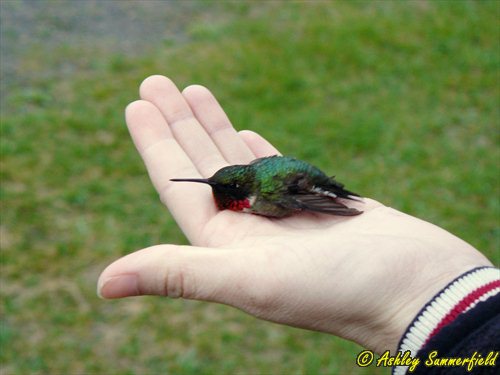
Hummingbirds (ruby-throated)- beautiful, surreal, weigh less than nothing; bordering on pathetic, they utter pitiful squeaks that sound like a baby mouse crying, and often require a few nudges before they realize they are free to fly away.

Some birds don't like to be photographed.  This Wood Thrush was giving Seabrooke, the bander in charge, a piece of her mind.

I often found flycatchers tricky to identify, as I was often fooled into thinking they were some kind of warbler. They are larger, have bigger heads, and are generally cuter (in my opinion), and have a small hook at the end of their bill for snatching insects out of the air.  This Yellow-Bellied Flycatcher is puffing himself up to look more imposing.  Are you intimidated yet?

Many of the crested birds, like the Blue Jay above, will flatten their crests when you are holding them.  This Eastern Kingbird is breaking the mold and doing his best to look tough, even showing off the rarely visible red streak in his crest.  "You wanna piece of me?!"

Yellow-Shafted Flickers became instant favourites of mine.  These attractive members of the woodpecker crew are sizable birds, as you can see, and they make you work for a photograph.  One of the flickers we banded even resorted to rapidly pecking at the air in an act of defiance, a display which I can assure you looked incredibly silly.  Male Yellow-Shafted Flickers can be easily distinguished from the females by their prominent black mustaches.

Perhaps the smuggest of the birds is the Rose-Breasted Grosbeak.  With his dashing black tux and bold red cravat, he has every right to be smug.  His distinguished appearance is enhanced by his powerful beak, capable of cracking large nuts or inflicting painful bites to careless banders.

Another favourite of mine were the American Goldfinches.  Sure they look cute, but it's their gentle, whistling chirps that really melted my heart.  I had a pair get caught side by side in one of the nets, and they chatted back and forth as I extracted them. I like to think that they were reassuring each other that everything was going to be alright.


Is there any bird quite as dashing as the Baltimore Oriole?  This older male's crisp black and orange plumage was almost fluorescent.  He knows he's good looking.

There were many Tree Swallows that called the bird observatory home.  Every day I watched them swoop and dive with ease and grace.  I think it would be a lot of fun to be a tree swallow for a day, and I kept hoping that one of these skilled fliers would eventually get caught in one of the nets.  I got my wish on one of the last days of the season.  Looking sleek and dramatic, it is quite obvious that this bird is built for speed.

Last but certainly not least, my all-time favourite bird is without a doubt the Cedar Waxwing.  The superheroes of the bird world, these truly cool birds sport a badass zorro mask, flashy yellow tips on their tail feathers, and namesake red "wax" droplets on their wings.  Obviously they're not actually wax, but instead modified feather shafts that extend past the feather barbs, and are bright, shiny red.  Go on, I dare you to not love this bird!
As luck would have it, the last bird caught in the last net on the last round of the last day was a Cedar Waxwing.  An excellent way to end a great season!
"In brightest day, in  blackest night, no evil shall escape my sight..."

Thursday, May 19, 2011

A Bird In Hand

I consider myself a biologist of creepy-crawlies.  I'm an amphibians-reptiles-insects kind of biologist, with pretty good plant skills.  Birds and I have never really spent a great deal of time together.  I'm not a morning person.  The great thing about working with "cold-blooded" organisms like amphibians, reptiles, and insects, is that they don't get up before the sun does because they need a while to warm up.  With insects and reptiles you can easily start your day at 10am and not really miss anything, the best time for amphibians starts at dusk, and plants are there all the time and will adjust to your schedule (so nice of them, don't you think?).  In the birding world, your day is ending around 10am.  This scheduling conflict has left an enormous gap in my skill set.

Carefully extracting a Black and White Warbler from the mist  net
This spring I decided it was about time to fill in that gap.  Lately my alarm has been going off at 3:30am.  That's right folks - the middle of the night.  This used to be about the time I would be going to bed, not getting up.  So I drag myself out of bed (usually not until 3:45), and get myself down to the Innes Point Bird Observatory for 4:50am.  Every spring, bird observatories across the country (and the world) put up mist nets to catch birds as they pass through during their migration.  They extract the birds from the nets, measure them, weigh them, put a band on their leg, and send them on their way.  The data they collect is used to study population trends, among other things.

A Chestnut-sided Warbler in "photographer's grip"
As an intern at the IPBO, I am learning how to correctly handle birds and extract them from the nets.  Along the way I'm learning how to identify the various birds that we encounter, and I'm trying to learn to identify their songs.  So far I've managed to figure out some of the sparrow songs, but I'm finding the "birding by ear" bit to be pretty tricky.  There are so many birds that I never even knew existed!  For example, I've seen 9 different species of warbler so far, none of which I'd ever seen before.

Oh-so-cute Yellow warbler.  This wee guy weighs about as much as a loonie.
While we're out checking the nets we sometimes encounter other non-avian wildlife, like this adorable BABY PORCUPINE!  About the size of small canteloupe, this little ball of puff was just hanging out near one of the nets.  He was sitting so still I nearly missed him!  I'll bet under all that puff he's only about the size of a chipmunk.  

OMG Porcupine baby!!
You can follow all of my sightings on my Project Noah page!  If you're not already familiar with Project Noah then you should definitely check it out - it's like social networking for nature lovers!  It's a place for you to share all of your nature spottings with fellow nature enthusiasts, earn patches, join missions, and get help identifying things you're not quite sure of.  They have a mobile app for Android and iPhone so you can post your spottings on the fly, or check out what other people have spotted in your area!

Saturday, April 16, 2011

Urban ducks

I grew up in the Ottawa Valley, a mere half hour to our nation's capital, and yet, I don't think I really explored the city much until quite recently.  It has a surprisingly large amount of green space, and the bike trails that connect them all are pretty awesome.

Last week I went for a 22km bike ride through the city, using almost exclusively the multi-use pathways.  I started in Vanier, following the Rideau River south to Lees avenue, where I crossed the river and found my way to the Rideau Canal.  I toured the canal to Dow's Lake and looped through the Arboretum before returning to Vanier.  After my tour, I felt like I knew the city better, like all that time spent travelling around it in a car only skimmed the surface.  I encountered many people biking, jogging, and walking.  It felt so good to be outside in the sunshine and appreciating the urban wildlife. 

Mallard couple and Wood duck couple on a double date

Along my travels I spotted lots of ducks, particularly along the Rideau River.  Mallards (Anas platyrhynchosi), Wood ducks (Aix sponsa), and even a merganser were seen cruising through the city.

Female merganser - Hooded I think?
I think this was a female Hooded Merganser (Lophodytes cucullatus), and I really really hope I'm right, because if there are female hooded mergansers around, the males can't be far behind, and in my opinion, male hooded mergansers are the silliest looking creatures we have here in Canada.  You be the judge. Go on, I dare you to show me a more absurd Canadian animal!

Lady Wood Duck

Male Wood Duck - he knows he's good looking
The wood ducks were pretty cool to see since I haven't seen them very often before.  I guess I was looking in all the wrong places, since there were several pairs along the Rideau River last week. Wood ducks nest in tree hollows or man-made nest boxes.  You may remember this scene from Planet Earth when the Mandarin Ducklings (the European relative of the Wood Duck) take their leap of faith from their nest way up in the trees.  Habitat loss (including loss of suitable trees for nesting) and over-harvesting drove this once abundant species to near extinction in the early 20th century.  Protection by the Migratory Bird Treaty Act (1918) and the construction of man-made nest boxes allowed wood duck populations to rebound and they are no longer a species at risk.